Personal concierge services: what private, personalized help costs
What a personal concierge service does, how personalized concierge services are structured and priced, and how to tell the personal concierge companies apart.
What is a personal concierge, exactly
The question what is a personal concierge has a narrower answer than the marketing suggests. A personal concierge service is retained by a household or an individual to handle requests that require dealing with someone else (a restaurant, an airline, a contractor, a staffing agency), and not the ones that require dealing with your own paperwork.
Personal concierge services are therefore bought for reach, not for hours. The measure of one is not how much work it absorbs but how often it gets a yes where you would have got a no.
How personalized concierge services are structured
Most personalized concierge services are sold on a retainer with a named point of contact. The retainer buys availability and a person who accumulates context: which airline you will not fly, which restaurant table you dislike, which contractor is not to be used again.
That accumulated context is the actual product, and it is why switching providers is more expensive than the fee difference suggests. A personal concierge service in its first month is meaningfully worse than the same service in its sixth.
Comparing personal concierge companies on private access
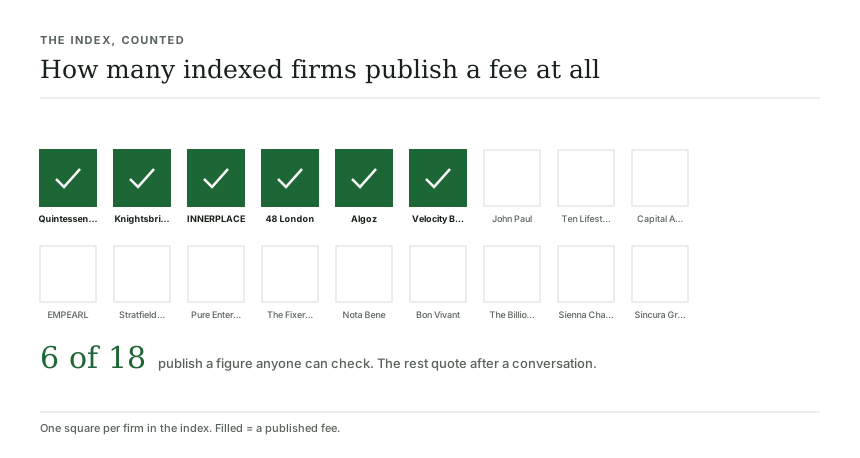
Personal concierge companies compete on relationships that are difficult to verify from outside. Every firm claims access; few will tell you where it is thin. The practical test is to ask about a specific venue or route in the month you actually need it, and to notice whether the answer is specific.
A private arrangement of this kind is also worth judging on what happens when the answer is no. Firms that describe a fallback are describing a real process. Firms that only describe successes are describing a brochure.
What a personal concierge service costs
Cost follows the engagement model; the label on it changes nothing. A retained personal concierge sits in the monthly retainer band; occasional use sits in the per-request or hourly band; year-round membership with a dedicated manager sits in the annual band and is an order of magnitude above the others.
The mistake worth avoiding is buying an annual membership for a volume of requests that a per-request arrangement would have covered for a fraction of the cost. Estimate volume honestly before choosing the model.
Questions worth asking before you retain anyone
Ask who covers your named contact when they are away, and whether that person inherits any of your history. Ask for the escalation path on a request that arrives outside working hours. Ask which costs are passed through at cost and which carry a margin, because the answer varies more than the headline fee does.
Then ask something specific and awkward: a venue you actually want, in the month you actually need it. The quality of that single answer tells you more than the whole capability deck, because it is the only question in the conversation that cannot be prepared in advance.
What the first month of a personal concierge service looks like
Very little of the value arrives immediately, and households that expect it to are frequently disappointed by an arrangement that turns out fine. The first month is largely transfer: preferences, standing accounts, the people already involved in a household, the requests that recur and the ones that must never be handled a particular way. A provider that does not run a structured intake is going to learn all of it by making mistakes on live requests instead.
A good intake produces a document, and a conversation is not a substitute. It lists the recurring categories, the decision limits, the payment mechanism, the people who may be contacted on your behalf, and the escalation route when the named contact is unavailable. Ask for it, and ask to correct it, because the version the provider writes after one meeting is always partly wrong in ways that are cheap to fix at that point.
Judge the arrangement on the second month; the first measures the wrong thing. The first measures how well a firm gathers information; the second measures whether it uses what it gathered, which is the actual product.
Which request categories providers are genuinely good at
Capability is uneven and the unevenness is predictable. Restaurants, travel logistics, tickets to events that sell tickets, and the administrative long tail of a household are handled competently by almost every firm in this category, because that work is process and needs no relationship behind it. Those are the requests where the comparison between providers is really about responsiveness and price.
Three categories separate firms sharply. Access to things that are allocated and never simply sold, which depends entirely on standing relationships. Anything requiring physical presence in a market where the firm has none. And genuinely unusual requests, where the work is a search with an uncertain outcome and the honest response describes the search and promises nothing.
Asking a provider to name the last three requests it declined, and why, is the most efficient way to find the boundary. Firms that decline nothing are either extremely capable or not tracking their failures, and the follow-up question distinguishes the two quickly.
Response commitments and what they actually promise
Most arrangements carry a response commitment and most of them are weaker than they read. The distinction that matters is between acknowledgement and resolution: a firm that guarantees a reply within the hour has promised an email, not an answer, and the two are frequently a week apart on anything difficult. A commitment worth having names both, separately.
Out-of-hours coverage is the second layer, and the honest question is not whether it exists but who answers. A duty rota staffed by people with no access to your history can take a message and little else. A named contact reachable directly is a different arrangement and is usually priced as one.
The third layer is what happens during the periods the whole market is under pressure, which are knowable in advance from the local calendars. A provider that has thought about capacity in those weeks will say how it is managed. One that has not will discover it at the same time you do.
The named contact problem
The accumulated context that makes a personal concierge service efficient lives with a person, not with a firm, and that creates a dependency nobody enjoys discussing. When the named contact is on holiday, unwell or has left, the arrangement is only as good as what was written down and who else can read it.
Three questions settle it. Who covers, by name. Whether that person holds any of your history or starts from nothing. And what the firm does when the named contact leaves altogether, which is the case that produces the most abrupt drop in service quality anywhere in this category.
Firms answer these very differently, and the answers correlate with size, and not at all with price. A larger firm typically has a shared record and weaker individual continuity; a smaller one has the opposite. Neither is better in the abstract, and knowing which trade you have bought is what matters.
How money moves, and where the mark-ups hide
Two mechanisms are common and they behave differently. In the first, the provider pays third parties and rebills you, which is convenient and creates an obvious question about whether anything is added on the way through. In the second, you pay third parties directly and the provider bills only its own fee, which is more administratively tiresome and much easier to audit.
Neither arrangement is improper, and mark-ups on pass-through costs are a legitimate way for a firm to be paid. The problem is only ever the undisclosed version. Ask directly which costs are passed through at cost, which carry a margin, and whether the firm receives anything from suppliers it recommends. The answer should be a policy; an assurance is not one.
Set a spending limit in a number and put the payment mechanism in writing, including who holds card details and how a card is replaced. This is the least interesting part of the arrangement and the one that produces the most avoidable friction.
Testing an access claim before you rely on it
Access is the thing every firm claims and the hardest thing to verify from outside, so it is worth testing cheaply before it matters. The method is a specific request in a specific market in a month you actually care about, ideally at a scale small enough that being wrong costs little. What is being measured is not whether the firm succeeds but how quickly and precisely it establishes whether it can.
A useful answer sounds like a mechanism: who they would approach, what the realistic odds are, by when they will know, and what the alternative is if it fails. An unhelpful answer sounds like confidence. The difference is visible within a day and is a better predictor of the arrangement than any amount of reference-checking.
Apply the same test to a market the firm lists but is unlikely to be strong in. A provider that admits a weakness in one market and demonstrates strength in another is describing a real coverage map, which is more valuable than a uniform claim across fifty cities.
Structuring a trial instead of committing to a year
Annual commitments are the norm in this category and are frequently unnecessary at the start. A shorter initial period, priced per request or on a monthly retainer, answers the questions an annual contract only answers expensively: whether the volume estimate was right, whether the named contact suits the household, and whether the categories that matter are the ones the firm is good at.
A trial designed to be informative has a defined length long enough to cross a busy period, a small number of requests deliberately chosen to span easy and difficult, and an agreed review at the end against something other than satisfaction. Most firms will accommodate it; the ones that refuse are telling you something about how the relationship will be run.
If the trial converts, the annual arrangement is then negotiated with real volume data in place of an estimate, which is the strongest position a buyer occupies in this market and one that a year-long first commitment gives away for nothing.
Leaving, and what a handover should contain
Because the product is accumulated context, ending an arrangement costs more than the notice period suggests. The material that took a year to build sits partly in a system and partly in a person, and only the first part is recoverable unless the contract says otherwise.
A handover worth the name returns the preferences record, the standing arrangements made in your name, the account and booking references held on your behalf, and a list of the suppliers engaged and on what terms. It should also confirm the deletion of what is not returned. Agree that list when signing, because it is the only moment both sides want the ending to be tidy.
The same list is what makes a switch survivable. A new provider given a complete preferences record and a supplier list reaches useful in weeks where it would otherwise take months, which changes the arithmetic of moving from prohibitive to merely inconvenient.
Where the cost actually lands over a year
The published bands describe the fee and not the outgoing. A retained arrangement generates spending decisions that would otherwise have been avoided by inertia, and households commonly find their first year with a provider more expensive in total than the year before it even where the fee was modest. That is not a criticism of the arrangement; it is what happens when the friction that suppressed a decision is removed.
The controllable version of this is the decision limit and a reporting cadence. A monthly summary of what was spent and on what, agreed at the start, turns the effect into something visible, so it is never discovered late. Providers rarely offer it unprompted and rarely object to it.
The rate estimator converts the published bands into a monthly figure at a stated request volume, and the crossover it calculates between paying per request and holding a retainer is the single most useful piece of arithmetic before committing to either.
Regional differences in what the arrangement is expected to be
The same service is understood differently in different markets, and a household moving between them commonly finds the arrangement it is used to does not translate. In some markets the expectation is a discreet intermediary who is never present; in others it is closer to an executive assistant who attends. Neither is more correct, but a provider working to one convention for a client expecting the other produces a persistent low-grade mismatch that nobody names.
The practical consequence for a multi-market household is that a single provider is easier to manage and frequently weaker in at least one market, while a provider per market is stronger locally and produces no accumulated context anywhere. The choice depends on where the difficult requests actually arise, and not on where the household spends the most time, and those are often different places.
The market pages carry the one variable that is genuinely local, which is how far ahead a request has to be placed. Fees do not move between cities; expectations and lead times do.
Signals that an arrangement is not working
The failure is rarely dramatic. What happens is that requests start being handled by the household again because it is quicker, and the fee continues. Two or three months of that is the point at which most arrangements should be reviewed and most are not, because nothing has gone visibly wrong.
Three earlier signals are worth watching. Requests coming back with questions the provider should already know the answer to, which means the preferences record is not being used. A rising share of requests that are acknowledged and then drift. And a named contact who changes without being announced, which is usually the first visible consequence of a change inside the provider.
Raising any of them early tends to work, because a provider in this category loses money on churn and knows it. Raising them at renewal, when the decision has effectively been made, mostly produces a discount that fixes nothing.
Judging a provider on what it does badly
Every firm presents its strengths and the presentations are close to interchangeable, so the informative material is on the other side. A provider that can describe, unprompted, the kinds of request it handles poorly and the markets where it is weak is describing a real operation. One that presents uniform capability across every category and every city is describing a brochure.
The same applies to failures. Asking what went wrong on a recent engagement, and what changed afterwards, produces either a process improvement or an anecdote about a difficult client. Both answers are useful and only one of them is encouraging.
This matters more in this category than in most, because the buyer cannot inspect the product before purchase and the marketing carries no distinguishing information. Weakness stated voluntarily is close to the only credible signal available before the first request.
Frequently asked questions
What is a personal concierge responsible for?
Requests that require dealing with a third party on your behalf (bookings, access, procurement, staffing), and not your own administration.
How do personal concierge companies differ from each other?
Mostly in where their access is genuinely deep. Ask about a specific venue in a specific month; the service list will not tell you.
Is a personal concierge service worth it for occasional use?
Rarely on a retainer. Occasional needs are better served by per-request pricing; retainers only pay back at steady volume.
What does personalized mean in this context?
A named contact who accumulates your preferences over time, as opposed to a shared desk that starts from zero on each request.
How long before a personal concierge service becomes useful?
Several months. The value comes from accumulated context, which is why frequent switching is more costly than it looks.