Personal assistant services: virtual, private, and what they cost
What personal assistant services actually cover, how virtual assistant services differ from a private assistant on your payroll, and which arrangement suits which situation.
What personal assistant services cover
Personal assistant services sit inside your routines; a concierge works outside them. The work is calendar, correspondence, travel booking, household coordination and the steady administrative load that accumulates around anyone with more commitments than hours. The defining feature is direction: an assistant does what you ask, in the order you ask, to your preferences.
That is the whole distinction from a concierge, and it is worth stating plainly because the two are sold as though they were interchangeable. A concierge negotiates with third parties on your behalf. An assistant works inside your world. Firms that offer both usually price them separately for exactly that reason.
Virtual assistant services and where they stop working
Virtual assistant services are the cheapest entry into the category and the fastest to arrange. A virtual personal assistant handles anything that can be done from a laptop: inbox triage, research, scheduling, expense reconciliation, supplier chasing. Published market pricing puts this tier well below a retained concierge arrangement.
The limit is physical presence. A virtual personal assistant cannot let a contractor in, meet a delivery, or stand in a queue, and the moment a meaningful share of requests need someone in the room, the arrangement stops saving time and starts costing it. Most people discover this boundary by crossing it, never by planning for it.
When to hire a private assistant directly
The decision to hire directly is a trade: maximum continuity for maximum overhead. A private assistant on your own payroll learns your preferences properly and holds context no agency can rebuild each time. You also take on employment - taxes, benefits, cover during holiday and sickness, and the management burden of being someone's employer.
The category of personal assistant for private individuals is where this arrangement is most common, and where the headline salary is least representative of the real number. Employer costs, agency placement fees and backup coverage all sit on top of it. Anyone budgeting to hire a personal assistant for private individuals should price the replacement cover as well, because that is the line most first-time employers forget.
What it costs and how to compare quotes
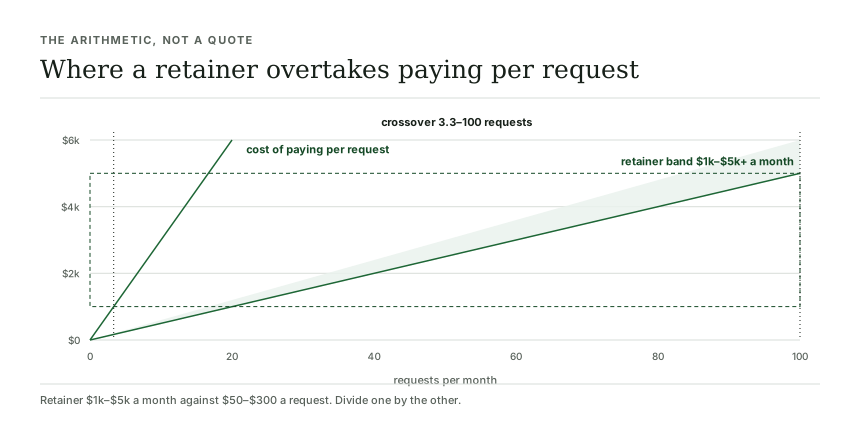
The cost question has no single answer because the four engagement models are priced on different units: per request, per hour, per month and per year. Comparing a monthly retainer against an hourly rate without normalising the volume produces a meaningless result, which is the most common mistake people make at this stage.
The estimator sets the published ranges side by side. What it cannot tell you is the volume you will actually generate, and that is the variable that decides which model is cheapest for you.
The three ways to buy, and what each one actually costs
There are three routes into this category and they carry very different total costs. A virtual arrangement is bought by the hour or by a monthly block from an agency or an individual, starts within days, and carries no employment obligations. An agency placement finds a person who then works for you, usually for a fee expressed as a percentage of first-year salary, with the agency carrying the search and some replacement guarantee. A direct hire is a straightforward employment relationship that you run yourself.
The comparison people make is between the hourly rate and the salary, and it is the wrong one. A direct hire brings employer costs that vary by jurisdiction but reliably include payroll taxes, statutory leave, sick pay, insurance and the cost of covering absence, and none of those appear in the headline figure. An hourly arrangement carries none of them and buys no continuity in return.
The honest way to compare is annual and all-in: what the arrangement costs over twelve months including the cover you will need when the person is unavailable, against how many hours of genuinely useful work it produces. Doing that arithmetic before speaking to anyone is what stops the conversation being anchored on a monthly retainer that looks small.
Writing the role down before hiring anyone
Most unsatisfactory assistant arrangements were unsatisfactory in the specification, and only rarely in the person. The document that prevents it is short: the recurring work by category, the hours it needs and when they fall, the decisions the assistant may take alone, the systems and accounts they will need, and the two or three things that would count as the role going well after six months.
The decision limits are the part that is almost always missing and almost always the source of friction. An assistant who must ask about every expenditure is slower than doing it yourself; one who commits without asking is a problem of a different kind. Setting a limit, in a number, converts a temperamental question into an administrative one.
Writing it down also makes the role comparable between candidates and between routes. The same document can be handed to an agency, used to brief a virtual provider, or posted for a direct hire, and the answers it produces are then about one job, and not about three different imagined ones.
Employment mechanics for a direct hire
Hiring someone into a household is an employment relationship with all the obligations that carries, and the obligations differ by jurisdiction in ways that are not intuitive. Payroll registration, a written contract, working-time records, statutory leave and employer insurance are the common minimum, and in several markets domestic employment carries its own specific regime that the general one does not cover.
The two areas that catch people out are cover and termination. Cover, because a single assistant is a single point of failure and the arrangement has to survive illness and holiday, which means either a second arrangement in reserve or an accepted gap. Termination, because the protections that apply to a household employee are frequently stronger than employers expect and the informality of the relationship makes documentation thin.
None of this argues against a direct hire. It argues for taking local advice once, at the start, and for treating the arrangement as employment from the first day, since converting it retrospectively when something goes wrong is the expensive route.
Confidentiality, access and the household record
An assistant accumulates access as a matter of course: calendars, correspondence, travel documents, payment cards, addresses, the names of family members and the routines of a household. That access is the reason the role works and it is also the risk that ought to be managed deliberately and never left to trust.
Three practical measures cover most of it. A written confidentiality term that survives the end of the arrangement. Named accounts in place of shared credentials, so access can be withdrawn cleanly and it is visible who did what. And a defined offboarding checklist covering keys, cards, accounts and devices, agreed while the relationship is good.
For a virtual arrangement the same questions apply to the provider and not to any one individual. Ask who inside the firm can see your material, whether the person assigned to you changes without notice, and what happens to stored documents when the arrangement ends.
The first ninety days
An assistant is not useful on day one and the gap is longer than most people expect. The work is preference-dependent, and preferences are held in someone's head and almost never written down: which airline, which seat, which restaurant is acceptable for which kind of dinner, who may be put through and who may not. Until that is transferred, the arrangement generates almost as much work as it absorbs.
The transfer can be accelerated deliberately. A written preferences file built in the first month, kept by the assistant and reviewed once, saves months of correction and has the useful side effect of surviving the person. A weekly review in the first six weeks, dropping to monthly, catches the misunderstandings while they are still cheap.
Judge the arrangement at ninety days; thirty is too early. Thirty days measures how quickly someone learns a household; ninety measures whether they can run it, and the two are different qualities.
When an assistant is the wrong answer
Three situations are commonly misdiagnosed as an assistant problem. The first is an access problem: the thing needed is not more hours but a relationship with a venue, an airline or an agency, and that is what a concierge arrangement is for. The second is a management problem: a household with staff, several properties and standing obligations needs someone holding responsibility, which is a different job from executing tasks, which is lifestyle management.
The third is an organisational problem inside a business, where the work is genuinely administrative but belongs to a role the organisation has not created. An assistant hired privately to absorb it works until the volume grows, at which point the arrangement has quietly become an unbudgeted headcount without any of the structure that would come with one.
The roles comparison sets the four adjacent jobs side by side, and the distinction it turns on is who holds the relationship with third parties.
An assistant works inside your routines and under your direction; a concierge works outside them and on your behalf.
Getting a virtual arrangement to work
Virtual assistant services fail for predictable reasons, and most of them are avoidable. The commonest is a task list that requires context the assistant does not have, which produces a stream of clarifying questions and the impression that delegation costs more than doing it. The fix is to start with a small number of complete, self-contained processes and leave the general offer of help out of it.
Time zones cut both ways. An assistant several hours ahead can complete overnight work that is waiting in the morning, which is genuinely valuable for research, scheduling and correspondence. The same gap is a liability for anything that needs a real-time decision, and an arrangement that mixes the two without acknowledging it produces delay at exactly the wrong moments.
Ask how substitution works before it happens. Many virtual providers assign a person but reserve the right to change them, and the accumulated context that makes the arrangement useful does not necessarily move with the account. A provider that maintains a shared preferences record has thought about this; one that relies on the individual has not.
Combining an assistant with other arrangements
The two are not alternatives and the most workable arrangements often use both. An assistant handles the recurring load inside your routines at a low hourly cost. A concierge is engaged for the small number of requests that need reach and not hours, and is paid per request instead of retained, which keeps the expensive resource matched to the expensive problem.
The boundary should be explicit, because the failure mode is the assistant attempting an access problem out of willingness and burning a week on it. A simple rule works: anything that requires a relationship the household does not have goes out, everything else stays in.
Where volume is high enough to justify both a retained concierge and a full-time assistant, it is usually also high enough to reconsider the structure entirely, and the question becomes whether the household needs one manager in place of two executors. That is the point at which the published bands stop being the useful comparison and the total cost of the arrangement starts being it.
What a private assistant costs beyond the salary
The salary is the visible part and rarely the largest part of the change in outgoings. Employer contributions and statutory entitlements sit on top of it in every jurisdiction that regulates domestic employment. Beyond those there is the cost of equipment and a phone, any travel the role requires, and the recruitment cost where the arrangement is placed through an agency instead of found directly. Where the assistant travels with a household, accommodation and subsistence during that travel are a real and frequently unbudgeted line.
Cover is the item most often left out entirely. An assistant on holiday or unwell is an arrangement that stops, and the household either absorbs the gap or pays twice for a period. Deciding in advance which of those two applies is cheaper than deciding it during a difficult week.
Against that, the direct hire is the only arrangement that produces genuine continuity, and continuity is what makes the role efficient. The trade is stated plainly at the top of this page and it does not resolve in either direction for everyone: maximum continuity for maximum overhead, or minimum overhead for a relationship that has to be rebuilt each time it changes.
Turnover, and why the second arrangement is easier
Assistant arrangements end, and they end more often than households expect. The role is demanding, frequently isolated, and it has a natural ceiling that ambitious people reach in a couple of years. Planning on the assumption that the arrangement is permanent is what turns an ending from inconvenient into disruptive.
The second arrangement is almost always better than the first, for one structural reason: by then the household knows what the role actually is. The specification is real by then and no longer imagined, the preferences file exists, the decision limits have been tested, and the handover has a document behind it. Households that treat the first arrangement as a draft of the specification get a great deal more out of the second.
That argues for building the transferable parts deliberately while the first arrangement is going well, because assembling them from memory during a notice period does not work. A preferences file, a list of standing accounts and contacts, and a short written record of how recurring work is done are all worth more at the point of change than anything else the role produces.
Vetting, references and the checks worth actually doing
The role carries access to a household long before it carries trust, so the checks belong at the start and are worth little after a problem. Identity and right to work are the baseline everywhere. Beyond those, the checks that repay the effort are two references taken by telephone, which written ones will not substitute for, and a conversation with the most recent employer about why the arrangement ended.
Written references in this category are close to worthless because almost nobody writes an unfavourable one. A telephone conversation produces hesitation, qualification and the sentence that begins with a pause, and those are the useful signals. Asking whether the referee would employ the person again, and waiting through the silence, is the single most informative question available.
Where an agency is placing the person, ask which checks the agency performed and assume none of them. Practice varies considerably, the guarantee period is not a substitute for diligence, and the household carries the consequence either way.
Making the arrangement survive the household changing
Households change: people move, families grow, a business is sold, someone starts travelling for half the year. An assistant arrangement scoped tightly to one situation becomes either underused or overwhelmed within a couple of years, and the adjustment is rarely made deliberately.
Two practices make the change manageable. Reviewing the specification annually against what the role actually did, and not against what it was hired to do, catches the drift while it is still small. And keeping the recurring work documented means the role can be expanded, reduced or split without starting again.
Where the volume grows past what one person can absorb, the options are a second assistant, a shift to a managed arrangement, or moving the access-shaped requests to a separate provider. The management route is the one most households arrive at, and the trigger is usually the appearance of standing responsibilities, which is not the same as more tasks.
Frequently asked questions
What is the difference between a personal assistant and a concierge?
An assistant works inside your routines under your direction. A concierge works outside them, dealing with third parties on your behalf. The difference is who holds the relationship, not who costs more.
Are virtual assistant services enough on their own?
They are, until a meaningful share of your requests need someone physically present. At that point the saving disappears, because you end up coordinating the coordinator.
Should I hire a private assistant directly or through a firm?
Directly buys continuity and context; through a firm buys cover, replacement and no employment obligations. Steady, predictable workloads favour direct hiring; variable ones favour a firm.
How much do personal assistant services cost?
Published guidance puts hourly arrangements at $75 to $250 an hour and monthly retainers at $1,000 to $5,000 and up. Which is cheaper depends entirely on your monthly volume.
Do personal assistant services include travel booking?
Almost always, but only as booking. Securing something that is sold out or closed is concierge work and is usually priced separately.