Corporate concierge: business, employee and executive programmes
How corporate concierge services are bought and priced, what business concierge programmes cover, and why employee and executive tiers sit at different points in the structure.
What a corporate concierge programme is
Corporate concierge services are bought by an organisation and used by its people. That single fact explains most of what is unusual about the segment: the buyer is not the user, the contract is negotiated and never listed, and success is measured in retention and relocation outcomes, not in individual satisfaction.
Corporate concierge services are therefore sold to human resources and to executive teams, not to households. Providers in this part of the market often publish no consumer pricing at all.
Business concierge services and what they cover
Business concierge services usually cluster around three things: relocation support for incoming staff, travel and event coordination, and the administrative load around senior hires. A business concierge desk is judged on throughput and consistency; access to scarce venues is not what it is for.
The scope tends to be tighter than a household arrangement. What is included is defined in the contract, and requests outside it are either declined or billed separately, which is a difference worth understanding before rolling a programme out.
Employee concierge tiers in the workplace
An employee concierge benefit is the broad, shallow tier: available to many people, capped in volume, and aimed at removing everyday friction. Employee concierge services of this kind are priced per head and are closer to a benefits product than to a personal arrangement.
Workplace programmes live or die on uptake. A workplace benefit that a third of staff never use is expensive per actual request, which is why providers report usage and not headcount.
Executive concierge services at the top of the structure
Executive concierge services are the narrow, deep tier: a small number of senior people, a named manager, and scope closer to a private household arrangement than to a staff benefit. Many organisations run both tiers simultaneously through the same provider.
Because an executive arrangement blends business and personal requests, the boundary should be written down. Firms that have handled this before will propose one; firms that have not will leave it to become a problem later.
How a corporate concierge programme is actually bought
Procurement in this segment looks nothing like a household engagement. A corporate concierge programme is normally scoped by human resources, priced against headcount when requests are what it will actually deliver, and reviewed by procurement and legal before anyone signs. The people who will use the service are rarely in the room, which is the structural weakness of the whole process and the reason so many programmes are bought against an idea of demand that nobody has measured.
The sequence that works starts with a pilot. A single site, a single population, a fixed period long enough to cross a seasonal peak, and a small number of metrics agreed at the outset. A pilot answers the question no proposal can, which is whether the population will actually use the thing, and it converts the renewal conversation from an argument about value into a reading of numbers both sides already have.
Incumbency is worth naming early. Several of the largest providers in this segment reach corporate buyers through existing relationships, most often a bank, an insurer or an employee benefits platform, and the concierge element arrives bundled and was never chosen. That is not a reason to reject it, but it means the price is embedded and the comparison a buyer thinks they are making has usually already been made for them.
Pricing structures and what each one rewards
Four structures cover most of the market. A per-employee-per-month fee prices access for the whole population regardless of use. A tiered fee prices bands of headcount. A capped model buys a fixed pool of requests that the organisation draws down. A pure per-request arrangement prices nothing until something is asked for. Each rewards a different behaviour, and the mismatch between structure and population is where corporate programmes waste money.
A per-employee fee is efficient at high uptake and expensive at low uptake, so it suits a population that already expects the benefit and knows how to use it. A request pool is the opposite: cheap where use is sporadic, and it produces an unhelpful incentive to ration in exactly the weeks the service would be most valuable. Capped models also tend to run out in the same quarter every year, which is worth checking against the calendar before agreeing the size of the pool.
Whatever the structure, the number to establish is the effective cost per actual request over a full year, which the headline rate will not tell you. That figure is knowable at renewal and almost never appears in a proposal, and it is the only basis on which two structurally different offers can be compared.
Uptake is the number the whole programme turns on
A workplace benefit that a third of eligible staff never use costs three times its notional price per person who does. Uptake is therefore not a soft measure of satisfaction; it is the denominator under every other figure in the programme, and it is the first thing a renewal review should establish.
Uptake is driven by communication far more than by scope. Programmes that are announced once at launch and then left to circulate settle at a low plateau within a quarter. Programmes that are reintroduced at predictable moments, particularly around the periods when the population is under most pressure, sustain a materially higher rate. That is a cost the employer carries and the provider does not, and it is regularly left out of the business case.
Two secondary measures are worth tracking alongside it. Repeat use tells you whether the first experience was good enough to produce a second. Request mix tells you what the population actually needed, which is frequently not what the programme was scoped for, and it is the most useful input into the next contract.
Relocation, the single heaviest use case
For many organisations the corporate concierge programme exists mainly to support relocation, and everything else is secondary. The work is dense, time-bound and unfamiliar to the person going through it: housing, schooling, registration, banking, licences, utilities and the long tail of administrative steps that differ in every jurisdiction and are difficult to sequence from outside.
It is also the use case where a provider's coverage claim is tested hardest, because the work is unavoidably local. A firm that reaches a market through a partner can usually manage a restaurant booking there and cannot necessarily manage a residence registration, and the difference only becomes visible under deadline. Asking which relocations a provider has actually completed in the destination markets, and not which markets it lists, is the version of the coverage question that matters here.
The scope boundary needs writing down for the same reason. Relocation support that quietly extends into the employee's personal affairs is the most common way a capped programme overruns, and the cleanest fix is a defined list of what the programme covers and a route for the employee to buy the rest privately.
Where the executive tier and the personal one blur
An executive arrangement is bought by the organisation and used, in practice, for a mixture of business and personal requests. That mixture is the point of it, and it creates three questions that are easier to settle at the start than at an audit: which requests the organisation is paying for, who sees the record of them, and what happens to the arrangement when the individual leaves.
The record question is the one most often overlooked. A programme run through an employer generates a log of an individual's personal arrangements held by a third party under a contract the individual did not sign. Providers experienced in this segment separate the executive tier's data from the corporate reporting by design, and can describe how. Those without that experience produce a management report that nobody wanted.
Continuity at departure is worth a clause of its own. The value of a mature arrangement is accumulated context, and a senior individual leaving the organisation usually wants to keep the person and has no use for the programme. Whether that is permitted, and on what terms, is a negotiation nobody wants to have for the first time on the day it happens.
Confidentiality, data and the parts legal will ask about
A programme of this kind necessarily collects personal information about employees, including family details, travel patterns and home addresses, and it collects it for the employer's supplier and not for the employer. The processing relationship needs to be established explicitly: who is the controller, what is retained, for how long, and what happens to the record at the end of the contract.
Access inside the provider matters as much as the contract. Ask how many people can see an individual's request history, whether the named contact's cover has full visibility, and how the provider handles a request an employee would not want their employer to know they made. Firms that have run executive tiers have thought about this; firms that have not will answer in generalities.
The practical test is the leaving process. A provider that can describe exactly what happens to an individual's data when they leave the organisation is describing a system. One that treats it as an administrative afterthought is telling you the record simply persists.
Why programmes fail, and what the failures have in common
Three failure patterns account for most of it. The first is a scope written for a population that does not exist, usually an assumption that staff will use the service for personal errands when what they actually need is help with work travel and relocation. The second is silence after launch, which produces the low-uptake spiral described above. The third is scope creep in the executive tier, which absorbs the capacity that was sold to everyone else.
All three are visible early in the request mix, and all three are cheaper to correct at a pilot review than at renewal. That is the argument for agreeing the measurement before the launch, because assembling it afterwards from whatever the provider happens to report.
The failure that is not the provider's fault deserves naming too. A programme introduced as a substitute for fixing a workload problem is being asked to do something no concierge arrangement can do, and it will be judged against that impossible standard at the first review.
Renewal, switching and what the second contract should change
By renewal the organisation holds something it did not have at the first negotiation: a year of actual request data. That converts the discussion from a proposal comparison into a specification. Uptake by site and by population, request mix by category, effective cost per request, and the periods when the service was under pressure are all now known, and every one of them is a lever on structure and price.
Switching provider is more disruptive than the fee difference usually suggests, for the same reason it is in a household arrangement: the value that accumulated is context, and it does not transfer. Where a switch is warranted, the handover terms are the part to negotiate hardest, and they should be agreed in the contract being signed and never in the one being left.
The alternative worth considering at renewal is a change of structure with the same provider. Moving from a per-employee fee to a request pool, or narrowing the eligible population to the group that actually uses it, frequently recovers more than a competitive tender would, and it costs none of the accumulated context.
How a corporate programme sits alongside private arrangements
An employee covered by a workplace programme may still retain someone privately, and the two arrangements answer different questions. The corporate programme is broad, capped and visible to an employer; a private arrangement is narrow, uncapped and not. Individuals at the executive tier commonly hold both, and the boundary between them is a matter of preference, with no rule deciding it.
For the organisation, the useful consequence is that a corporate programme does not have to cover everything. A programme scoped tightly around the things the employer genuinely benefits from paying for, with a clear route for staff to extend privately at their own cost, is cheaper and easier to defend than one that tries to be a household service for several thousand people.
The rate estimator and the membership options page cover what those private arrangements cost as published bands, and the roles comparison covers the adjacent question of whether an assistant would serve the same purpose more cheaply.
Global programmes and the coverage gaps nobody discovers until later
A programme sold as global almost never means the same thing in every market. Providers reach most of the world through partners, and the quality of a partner arrangement varies far more than the marketing suggests. The gap shows up in the places an organisation has few people and therefore did least diligence, which is precisely where an employee is most isolated when something goes wrong.
The way to test it before signing is to pick the three markets where the organisation has the smallest presence and ask, for each, who would actually take the call, in which language, during which hours, and what has been done there in the past year. A provider with real coverage answers in specifics. A provider without it answers about the network.
Hours are the underrated part. A programme staffed from a single hub covers a global population badly at the edges of the day, and the populations most affected are usually the smallest and least represented in the review. Asking where the service is staffed from, which is a different question from where the firm has offices, gets to it directly.
Language is the other. A relocation into a market where the employee does not speak the language is exactly the case the programme exists for, and it is the case a thin partner arrangement handles worst.
What to write into the contract
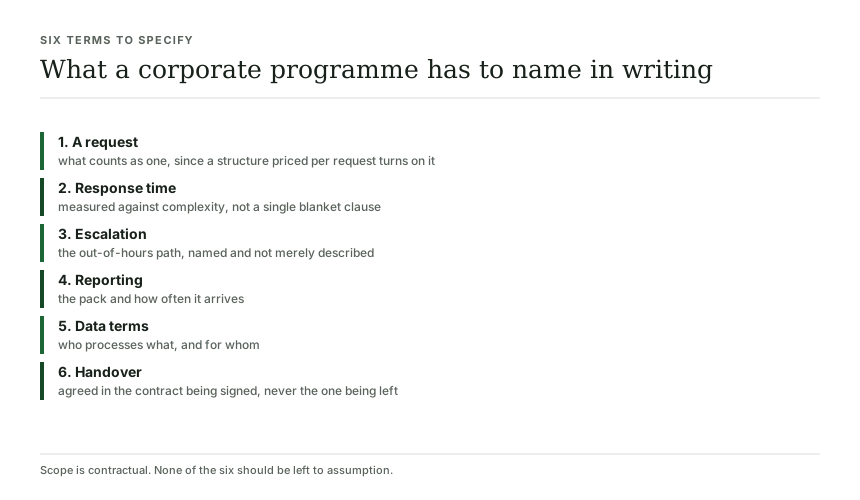
Six things are worth specifying and none of them should be assumed. The definition of a request, since a structure priced per request depends entirely on where one ends and the next begins. The response commitment, separated into acknowledgement and resolution, because a firm that acknowledges in minutes and resolves in weeks satisfies a badly written clause. The escalation path outside working hours, named, and not merely described. The reporting pack and its cadence. The data terms set out above. And the exit provisions, including what happens to the request history.
Two of those repay attention disproportionately. The definition of a request is what a capped programme lives on, and providers and buyers routinely count differently: a trip involving flights, a car and a restaurant is either one request or three, and the difference is a third of the pool. The exit provision matters because it is the only clause that is negotiated while both parties still want the relationship to work.
It is also worth agreeing what the programme will not do, in writing and in language the population will read. Most dissatisfaction in workplace programmes traces back to an expectation that was never in scope, and the cheapest place to correct that is the announcement, long before the individual refusal.
Reading a corporate proposal
Proposals in this segment converge on the same structure: a capability overview, a network map, a set of illustrative use cases and a price. Three of those four are effectively identical between providers, and the fourth is not comparable without the structural detail above. Reading them in the order they are written therefore tends to produce a tie broken by presentation.
A more useful order is to read the price structure first, then the response and escalation commitments, then the coverage answers for the markets that actually matter, and only then the capability material. That sequence puts the checkable things first and treats the narrative as context and never as evidence.
The question worth asking of every proposal is what the provider would measure at the first review if the decision were theirs. A firm that names uptake, repeat use and request mix is describing a programme it intends to manage. A firm that names satisfaction alone is describing one it intends to report on.
Frequently asked questions
Who buys a corporate concierge programme?
Human resources and executive teams, as a retention or relocation measure. The user and the buyer are different people, which shapes how it is priced.
What do business concierge services usually include?
Relocation support, travel and event coordination, and administrative help around senior hires. Scope is contractual, and never open-ended.
How is an employee concierge benefit priced?
Typically per head with a volume cap, closer to a benefits product than to a household retainer.
How do executive concierge services differ?
Fewer people, a named manager, and scope closer to a private arrangement, often blending business and personal requests.
Are corporate concierge rates published?
Rarely. Contracts are negotiated per organisation, and several of the largest providers in this segment publish no rates at all.